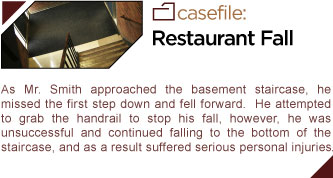
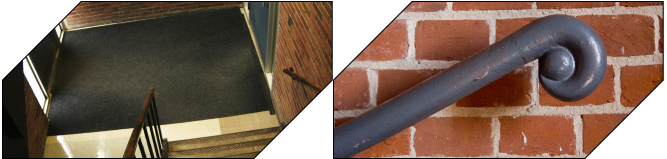
Dr. Pilette was retained to conduct a review of the construction details of the staircase, and to determine whether any deficiencies would have contributed to Mr. Smith's accident. The staircase components were examined in detail: dimensions of the steps, top and bottom landings, slip resistance of the walking surfaces, handrail, and lighting.
The investigation revealed that the staircase was original construction dating back to 1981. The construction details of the staircase met the requirements of the building code in effect at the time of construction. Newer handrails are required to meet geometric dimensions and be graspable. More stringent requirements in subsequent upgrade of the building codes cannot be enforced to existing construction, unless the building, or part thereof, is being renovated.
In this case, the handrail requirements in the newer building code were found to be more demanding than those in effect before 1981. However, those newer requirements could not be enforced. Despite the non-compliance to current building code, the existing handrail was not hazardous. It was found that Mr. Smith's incident was as a result of his own misfortune.