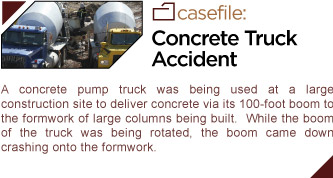
Dr. Pilette was retained several months later to the review the case and determine the factors that led to the incident. The photographic evidence was reviewed to determine the extent of damages and positioning of the equipment at the time of the incident, that is, deployment of the boom and the four outriggers used to stabilize the truck. The photographic evidence clearly showed that one of the four outriggers had structurally failed, thereby suggesting to those who witnessed the incident that the truck had tipped over as a result of the structural failure.
The evidence also showed that the outriggers of the truck had not been fully and properly deployed prior to pumping the concrete. The congestion and obstacles around the concrete pump truck did not permit the full deployment of the outriggers, nevertheless, the equipment was used. Stability of the concrete pump truck is solely achieved by the deployment of the outriggers, which creates a large footprint for the equipment thereby preventing tipping over.
Using the photographic evidence, Dr. Pilette determined the position of the boom and the effective footprint of the outriggers at the time of the incident . It then became evident that as the boom was being rotated to the next concrete pour location, the centre of gravity of the equipment (boom/truck) slowly moved outside of the footprint of the partially deployed outriggers. Tipping over of the truck occurred, causing one of the outriggers to fail.